Showing posts with label Alstonia. Show all posts

Friday, November 7, 2014

Creamy Woods Plantations (Pvt) Limited: Establishment of and Alstonia Plantation


Abstract of the presentation of
Chamathka Fernando

There are various types of Alstonia such as A. macrophylla, A. scholaris, A. boonei. The most common type found in Sri Lanka is A. macrophylla which is also known as Havarinuga, Wellai Maram and match stick tree. This species was introduced to Sri Lanka from Malaysia. A. macrophylla is mainly found in Malaysia, Indonesia, Thailand, Philippines, and Vietnam.

A. macrophylla is found in the wet and intermediate zones of Sri Lanka, mainly in and around plantations and also in forests. The tree height vary in between 20-25 m. This is a species which has a very straight bole with little taper. Generally the sapwood is yellowish white creamy and cannot be easily differentiated from the heartwood. The heartwood is more yellowish than sapwood. Grain is straight and shallowly interlocked. Texture is moderately fine to rather coarse and even. The timber is of superior quality to that of A. scholaris and less liable to attack of boring insects. It is used for making roof beams, frames, drawing boards, poles and toys A. macrophylla has been suggested for plantations and home gardens in Sri Lanka due to its fast growth rate, timber value and ease of establishment.

Creamy Woods Plantations (Pvt) Ltd. has an extent of 26 hectares. It is situated in Anguruwathota, Kalutara district. Company is introducing Alstonia macrophylla to the plantation sector of Sri Lanka for a greener economy and sustainable development. Beyond the production of timber, company involves in many alternative income generation paths while sustaining the company as well as the community.

Planting distance recommended for A. macrophylla is 3x3 m and initial tree density per hectare is 1100. Life span of A. macrophylla is nearly 15 to 17 years. Intercropping will be an alternative income generation method until the trees complete their life span and Ginger will be intercropped with A. microphyllla. Spacing in between the main crop A. macrophylla and Ginger will be maintained according to the standard levels. Establishment of the plantation will be done after the site preparation and silvicultural practices will be carried out such as weeding, fertilizing, pruning, thinning and etc.

As this species, A. macrophylla is a high dense, fairly durable, highly adaptable to different soil types in the wet zone and very high growth rate will generate a good market for the company and with the intercropping it will generate an alternative income to the company while serving the community.
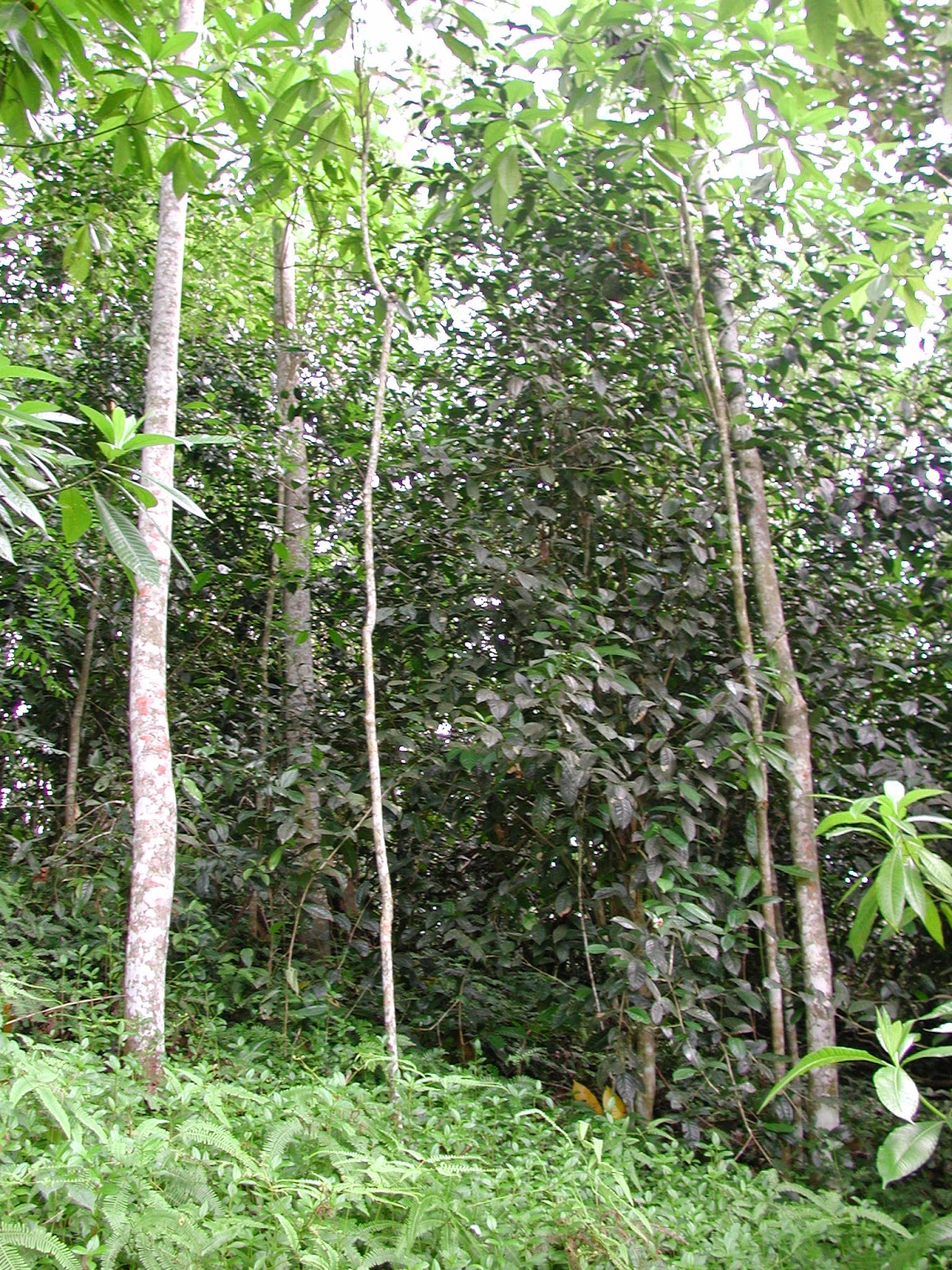
 

Alstonia trees growing at the edge of a home garden of Sri Lanka

Thursday, September 19, 2013

Establishment of Alstonia macrophylla (Hawari nuga) plantation company

Abstract of the presentation of 
Madhurangi Perera

Alstonia macrophylla is found in the wet and intermediate zones of Sri Lanka, mainly in and around plantations and also in forests. The tree grows to a height of 20-25m and has a very straight bole with little taper. The general characteristic of the wood are; however the sapwood is yellowish white creamy and cannot be easily differentiated from the heartwood. The heartwood is more yellowish than sapwood. Grain is straight and shallowly interlocked. Texture is moderately fine to rather coarse and even. A. macrophylla has been suggested for plantations and home gardens in Sri Lanka due to its fast growth rate, ease of establishment and timber value.

The Havarinuga Plantations which is established by the Havarinuga Plantations (Pvt) Ltd. has an extent of  25 hectares. It is situated in Galle. (from Yakkalamulla have to take Akkuressa road to Allaehala). It is only one and a half hours drive from Colombo via the new southern highway.

Havaringa Plantations (Pvt) Ltd. offers potential investors the opportunity to purchase blocks of land and cultivate Alstonia in the plantation. The plantation have separated 100 cultivation blocks of Alstonia. One block of land is 40 perch with 140 Alstonia trees . The investor can (if desired) obtain the full ownership of the land while all cultivation, maintenance and security will be provided by the company. The company has introduced easy payment schemes for all investors. The target market are the Foresters, nature lovers and local investors.Mutually beneficial Company Community Partnership is established.

Establishment of the plantation will be done after the site preparation, maintaining the nursery. Value Addition to the Alstonia plantations can be done through plantation management practices, Nursery management practices and by adding value to the final product of the plantation. Value to the plantation can be added as a whole, by obtaining plantation certification such as FSC and Rain Forest Alliance. Value addition at the nursery level can done be by importing genetically improved, best quality seeds from Malaysia and Taiwan. Value addition to the final product can be also done by seasoning the timber.

As final Products Post and Beams, Expose rafters are made. Wasted  small pieces use for photo frame manufacturing (Associate with Studios). Lower and middle income level customers are the target group for the products.


Come and join hands with us for a greener future  -Havarinuga Plantations-

Monday, June 29, 2009

Prediction of individual tree volume of Alstonia macrophylla

Construction of a precise growth model to predict the individual stem volume of Alstonia macrophylla
by
Rangika Bandara and Upul Subasinghe

In order to reduce the pressure on existing natural forests of Sri Lanka, Forest Department promoted growing timber species as plantations and in homegardens. Among the suggested species, Alstonia macrophylla (Hawari nuga) has recently become popular due to its faster growth rate, ease of estabishment and timber value.

However, at present, there is no method for estimating the stem volume of this species. Therefore mathematical models were built in this study to predict the individual stem volume of the selected species grown as plantations and in homegardens.

Hawari nuga is sidely found in wet zone of Sri Lanka and therefore the study sites were selected from Kalutara and Galle Districts. For the non-forest areas, sampling was carried out in individual basis and ten 0.02 ha circular plots with slope correction were randomly laid out for each plantation in order to measure the necessary parameters.

Dbh, total height and height to the crown base of the trees were measured. Necessary measurements were also taken to calculate the stem volume using Newton's formula.

A theoritical model structure was developed using the relationship between form factor, volume, basal area and total height. Regression analysis was used to fit the data into the model. Untransformed as well as transformed combinations of the model structures were tested in order to select the best models. After examining the statistical performances of the resultant models, two models were finally selected for plantation grown trees and open grown trees. Those models had very high modelling efficiencies and negligible bias. When validated with the reserved data at the beginning of the modelling procedure, the selected models proved the capability of predicting stem volumes of Alstonia macrophylla grown in plantations and homegardens.