Friday, November 7, 2014

Acacia Plantations Pvt Limited: Establishment of an Acacia Plantation

Abstract of the presentation of
Imalka Hitihamu

An ever-increasing demand for paper combined with a declining fibre supply from the forests is forcing the pulp and paper industry to find technically and economically viable fiber sources to supplement forest based resources. According to the world data records with regard to this implies that today a large amount of paper is produced from various annual plants (non wood fibers) in developing countries where forest resources are limited, For that sense we are making a plantation company for giving a solution to this demand for fibers which are raw materials of the paper and pulp making industry. 

Therefore we are using Acacia auriculiformis tree which suits well to our climatic conditions for come out a better solution for this. Acacia auriculiformis is an evergreen tree that grows between to 15-30 m tall, with a trunk up to 12 m long and 50 cm in diameter. It has dense foliage with an open, spreading crown. The trunk is crooked and the bark vertically fissured. Roots are shallow and spreading. Leaves are 10-16 cm long and 1.5-2.5 cm wide with 3-8 parallel nerves, thick, leathery and curved. Flowers are 8 cm long and in pairs, creamy yellow and sweet scented. Pods are about 6.5x1.5 cm, flat, cartilaginous, transversely veined with undulate margins. Acacia has a high calorific value. Also it has furniture, paper and pulp, medicinal as well as food values.

Land is situated in intermediate zone which provides best climatic and growing conditions to the optimum growth of the tree. Managing this Acacia land management plan will consists seed treatment methods, Nursery applications, Fertilizing, weed controlling and management of workman ship. For the value addition we are practicing intercropping and ginger will be used for this task which grows well in intermediate zone. This will become a successive effort of providing fibers for the paper and pulp industry and also it will become a profit making company.


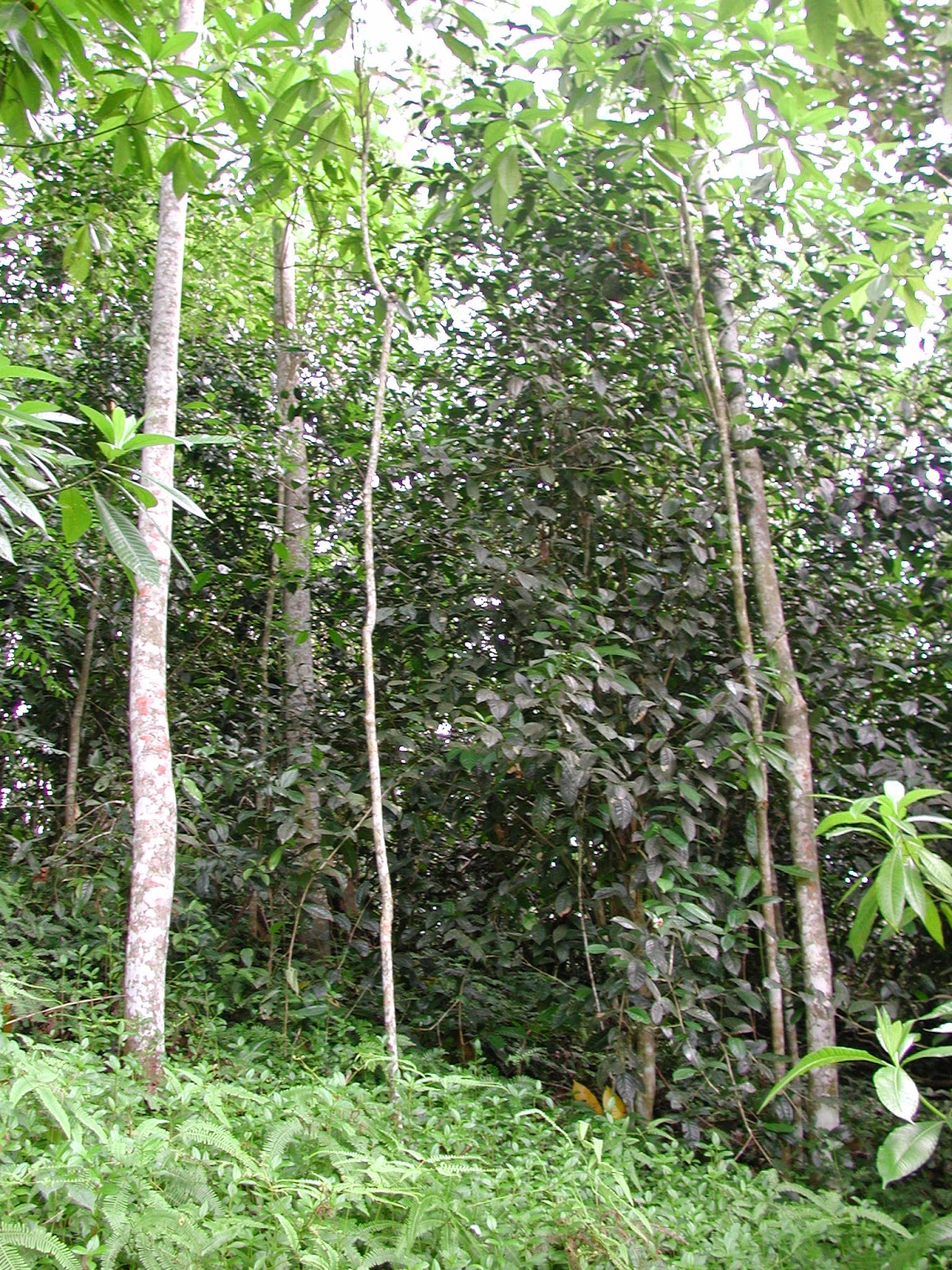
Acacia auriculifromis tree

Creamy Woods Plantations (Pvt) Limited: Establishment of and Alstonia Plantation


Abstract of the presentation of
Chamathka Fernando

There are various types of Alstonia such as A. macrophylla, A. scholaris, A. boonei. The most common type found in Sri Lanka is A. macrophylla which is also known as Havarinuga, Wellai Maram and match stick tree. This species was introduced to Sri Lanka from Malaysia. A. macrophylla is mainly found in Malaysia, Indonesia, Thailand, Philippines, and Vietnam.

A. macrophylla is found in the wet and intermediate zones of Sri Lanka, mainly in and around plantations and also in forests. The tree height vary in between 20-25 m. This is a species which has a very straight bole with little taper. Generally the sapwood is yellowish white creamy and cannot be easily differentiated from the heartwood. The heartwood is more yellowish than sapwood. Grain is straight and shallowly interlocked. Texture is moderately fine to rather coarse and even. The timber is of superior quality to that of A. scholaris and less liable to attack of boring insects. It is used for making roof beams, frames, drawing boards, poles and toys A. macrophylla has been suggested for plantations and home gardens in Sri Lanka due to its fast growth rate, timber value and ease of establishment.

Creamy Woods Plantations (Pvt) Ltd. has an extent of 26 hectares. It is situated in Anguruwathota, Kalutara district. Company is introducing Alstonia macrophylla to the plantation sector of Sri Lanka for a greener economy and sustainable development. Beyond the production of timber, company involves in many alternative income generation paths while sustaining the company as well as the community.

Planting distance recommended for A. macrophylla is 3x3 m and initial tree density per hectare is 1100. Life span of A. macrophylla is nearly 15 to 17 years. Intercropping will be an alternative income generation method until the trees complete their life span and Ginger will be intercropped with A. microphyllla. Spacing in between the main crop A. macrophylla and Ginger will be maintained according to the standard levels. Establishment of the plantation will be done after the site preparation and silvicultural practices will be carried out such as weeding, fertilizing, pruning, thinning and etc.

As this species, A. macrophylla is a high dense, fairly durable, highly adaptable to different soil types in the wet zone and very high growth rate will generate a good market for the company and with the intercropping it will generate an alternative income to the company while serving the community.


Alstonia trees growing at the edge of a home garden of Sri Lanka

Green Leaf Plantations Limited: Establishment of a Chinese Mahogany Plantation

Abstract of the presentation of
Sayuri Wicramasinghe

Toona Sinensis also known as Chinese Mahogany, is a deciduous tree. The bark is brown, smooth on young trees, becoming scaly to shaggy on old trees. The leaves are pinnate and the leaflets have an entire serrate margin. The flowers are produced in panicles and the fruit is a capsule. The growing area is up country zone in Sri Lanka mostly above the elevation of 1200 m. The harvesting age is 30 to 35 Years. The mature height is 20- 25 m. The mature DBH is 70 cm. The density is 424 kg per cubic-meter. Toona sinensis is class II timber grading.

Establishment and maintenance plan for Toona sinensis is prepared by a company named as Green Leaf Plantation Limited who is willing to establish a commercial Toona plantation in a barren land of upcountry. The company is mainly targeting to obtain a maximum profit by selling toona timber which is popular as a veneer and used for decorative purposes.

The mission of the company is to develop and operate high-quality and cost-competitive commercial Toona plantations producing lumber sustainably whilst providing environmental, social and economic benefit to local communities and the vision is to be Sri Lanka’s leading forestry company based on sustainability, environmental and social development benefits; with a passionate and determined team.

Land Preparation, planting and other treatments such as weeding, fertilizing, thinning, pruning and pest and disease control will be carried out in a very careful manner in order to obtain maximum volume of timber at the end of the rotation age of 30 years. Fencing and fire lining will be done in the early stages of the plantation establishment to prevent manmade and natural damages to the plantation.


Final stock will be about 220 to 250 trees per ha which will be removed by shelter wood system to minimize environmental damages which can be occurred in clear felling. Selected trees will be felled, extracted the moved to roadside and transported to the local market.

Golden Hope Plantation Pvt Ltd: Establishment of an African Mahogany Plantation

Abstract of the presentation of 
Rangika Beddevidana

African mahogany, Khaya senegalensis was introduced to Sri Lanka about 30 years ago and in the past 10 years it has become one of the priority species for timber plantation establishment in the dry zone. Timber is highly valued because of its beautiful figurative grain and its rich reddish mahogany brown colour. It is favored for furniture, high-class joinery, trim and boat building, railroad ties, flooring, turnery and decorative veneer.

The name of the hypothetical company is Golden Hope Plantation Pvt. Ltd and its management objectives are the production of high-value; high-quality timber on sustainable basis to relieve the pressure on our valuable rain forests, practice commercial forestry by earning higher income with inter-cropping.

At harvesting age, trees will be approximately 6 m in length and 50-60 cm in dbh with minimal taper and knots in 25 years, maintain plantation volume productivity, of 15-20 m3/ha/y merchantable volume over bark. Company is also aiming at achieving FSC certification enabling it to reach overseas markets.

A marginal land of 30 ha in the Dry Zone will be selected by considering several factors such as rain fall (1400 mm per annum), terrain (flat), accessibility, value. (low cost), soil condition, availability of natural water bodies and labour availability.

Land Demarcation will be carried out by surveying and establishing boundaries. Plots near the main roads or boundaries of the land will be kept by the company as a security. Main road of 5 m, sub-roads of 4 m will also be demarcated. Land clearing, removing shrubs, clear debris is carried out in late September, holing and planting carried out in early October and November targeting the NE monsoon. 650-700 trees per ha will be planted with a spacing of 3×5 m. Live fire belt will be established using Hana.


Proper maintenance practices will be established including fertilising up to 3 years and the commercial thinnings will be carried out at the ages of 14 and 20 years. Creeper cutting will be carried out from the 1st year while pruning carried out from 4th year before and after the rainy season. Watering is done using drip irrigation up to 3 years, 4 L per day in the dry season. Harvesting will be done using clear felling at the age of 25 years. 


A 6 year old African Mahogany Plantation in Intermediate Zone, Kurunegala, Sri Lanka

Wednesday, September 25, 2013

Establishment of plantation company for neem

Abstract of the presentation of
Umanda Rathnayake

Goldenleaves Company manages neem (Azadirachta indica) plantations in the dry and intermediate zones in Sri Lanka and their two main plantation sites are located in Korakanawewa and Anurapuraya. Main species of the plantation is Azadirachta indica which belong to the family Meliacea. Azadirachta indica originated in Burma or Indo-Pakistan sub continent. In 19th century , East Indian immigrants have carried the plants from particular region. Therefore tree improvement effort for Neem. Under Sri Lankan condition and it generally found in mixed forest system in Sri Lanka associated with several broad leaved tree species such as Acacia, Teak, Mahogany.

There are various silvilcultural methods, agro-forestry practices using in Azadirachta indica plantations. Management prescriptions starts from seed collection and it runs until doing the harvesting. Generally improved seeds can be taken from clonal seed orchards, seed production areas. Tissue culture to develop large scale uniform superior plants can also be practiced. Good silvicultural practices like proper spacing (2.5m×2.5m), pruning, weeding, thinning, pest and disease control can be done to produce high quality timer.

Seasoning, polishing furniture products, manufacturing timber products according to customer’s requirement, practicing seasoning methods, obtaining certain forest certifications will be add values to the end product.


Thursday, September 19, 2013

Establishment of Alstonia macrophylla (Hawari nuga) plantation company

Abstract of the presentation of 
Madhurangi Perera

Alstonia macrophylla is found in the wet and intermediate zones of Sri Lanka, mainly in and around plantations and also in forests. The tree grows to a height of 20-25m and has a very straight bole with little taper. The general characteristic of the wood are; however the sapwood is yellowish white creamy and cannot be easily differentiated from the heartwood. The heartwood is more yellowish than sapwood. Grain is straight and shallowly interlocked. Texture is moderately fine to rather coarse and even. A. macrophylla has been suggested for plantations and home gardens in Sri Lanka due to its fast growth rate, ease of establishment and timber value.

The Havarinuga Plantations which is established by the Havarinuga Plantations (Pvt) Ltd. has an extent of  25 hectares. It is situated in Galle. (from Yakkalamulla have to take Akkuressa road to Allaehala). It is only one and a half hours drive from Colombo via the new southern highway.

Havaringa Plantations (Pvt) Ltd. offers potential investors the opportunity to purchase blocks of land and cultivate Alstonia in the plantation. The plantation have separated 100 cultivation blocks of Alstonia. One block of land is 40 perch with 140 Alstonia trees . The investor can (if desired) obtain the full ownership of the land while all cultivation, maintenance and security will be provided by the company. The company has introduced easy payment schemes for all investors. The target market are the Foresters, nature lovers and local investors.Mutually beneficial Company Community Partnership is established.

Establishment of the plantation will be done after the site preparation, maintaining the nursery. Value Addition to the Alstonia plantations can be done through plantation management practices, Nursery management practices and by adding value to the final product of the plantation. Value to the plantation can be added as a whole, by obtaining plantation certification such as FSC and Rain Forest Alliance. Value addition at the nursery level can done be by importing genetically improved, best quality seeds from Malaysia and Taiwan. Value addition to the final product can be also done by seasoning the timber.

As final Products Post and Beams, Expose rafters are made. Wasted  small pieces use for photo frame manufacturing (Associate with Studios). Lower and middle income level customers are the target group for the products.


Come and join hands with us for a greener future  -Havarinuga Plantations-

Establishment of a forest plantation company using Michelia champaca (Gini Sapu)

 Abstract of the presentation of 
A. Jayaweera

Michelia champaca (Gini Sapu) is a large evergreen tree with a long, clean cylindrical bole (with 60-70 feet/14m-20m height; 1.8 m trunk diameter). Required rainfall varies from 2250 – 5000 mm and it performs well in an altitude of 500 -1500 m above mean sea level. It is well suited for sandy loam soil and also it grows well on moist deep, well drained, good quality soil. It is a light demander and coppices well up to a fair size and it does not produce root suckers.  
Michelia champaca is not native to Sri Lanka. Especially people used to plant this species around Hindu temples due to the sweet smell of its flowers. Now it’s being extensively planted in the wet zone and the hill country. Now it’s getting wild in our forest areas in wet and intermediate zones and can be found in home gardens also. No pure plantations have been established   for M. champaca in Sri Lank at present.

Champwood Lanka (Pvt.) Limited is a hypothetical company established with a vision to provide a helping hand in saving our rain forests. And its mission is to meet future demand for timber in Sri Lanka by using sustainable forest management. The selected area to establish the plantation is Kegalle with a land of 50 ha.

Management prescriptions and Business model consists with several steps as site preparation and establishment of a nursery, planting in the field and weed controlling, prunning and thinning and harvesting. There are various options for value addition such as proper management activities (fertilizer regimes, harvesting schedules), Carbon crediting, forest certifications, good quality seed collection and measures for soil erosion control. Intercropping is done for maximum land utilization.


End product manufacturing consist of logs, sawn timber, essential oil from flowers and seeds, some parts for ayurvedic treatments, fuel wood (through thinning and pruning) and plants and seedlings for reclamation and ornamental purposes. Dealing with customers in a responsible and faithful manner is the basis of been successful in the sector. However, there are considerable strengths, weaknesses, opportunities and threats which can be presented through a SWOT analysis.